Story by Charles E. Reineke. Photos by Luke Kenneally.
Sometimes it鈥檚 the little things that inspire our greatest efforts. Consider the race to save the Columbia Basin Pygmy Rabbit, one of the nation鈥檚 most desperately endangered animals.
Weighing in at just under a pound, these impossibly cute creatures are North America鈥檚 smallest rabbit. Perfectly adapted to the austere but beautiful sage and grass shrub-steppe they call home, thousands of pygmy rabbits once gamboled about the seas of sagebrush that provided them with shelter and sustenance.
No longer. These days, thanks mostly to the relentless pace of habitat destruction, slightly less than 150 individuals are left. Back in 2001, when the effort to save them began in earnest, there were 16.
Not so very long ago, our nation鈥檚 鈥渟agebrush sea鈥� stretched for more than 500,000 square miles, from the Dakota鈥檚 high plains to coastal California. Today, according to data compiled by the Nature Conservancy, that vast swath of sage is a shadow of its former self, down to just 150 million acres. And it is shrinking still, conservancy researchers say. More than one million acres are lost each year to invasive plant species, catastrophic wildfires, development, improper grazing and climate change.
Washington鈥檚 share of this arid shrub-steppe is no exception to this worrying trend.听 What was once an immense, interconnected habitat for a stunningly diverse array of plants, birds and other wildlife is now a highly fragmented patchwork. Remaining fauna and flora have been left bruised and battered.
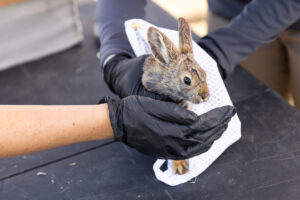
On a bitterly cold morning in December, 51福利社 research scientist Charlotte Milling and her team of Eastern student researchers are slowly pushing through a semi-enclosed portion of this endangered landscape, carefully bushwhacking through chest-high stands of sage, each gnarled plant painted white with frost. Some carry metal framed gentle-trapping gear. Others wield ungainly, soft-mesh-netted PVC contraptions. The goal is to round up pygmy rabbits for their semi-annual checkup and blood draw. The rabbits, understandably, are eager to avoid this.
Milling, an assistant professor of biology, is one of a small group of university scientists and wildlife management professionals who are working tirelessly to help Washington鈥檚 pygmy rabbits stave off extinction.
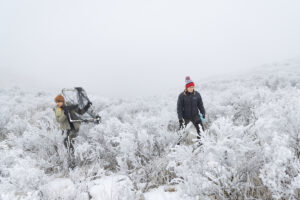
The work is centered around a strategy of gradually increasing rabbit populations using semi-wild breeding enclosures. These two-to-six acre, fenced areas essentially serve as nurseries for future wild populations. The goal is to help rabbits mate and rear their young 鈥� called 鈥渒its鈥� 鈥� in an environment that, while still wild, is mostly free from predators. 鈥淓verything eats pygmy rabbits,鈥� Milling says.
So far, the effort appears to be paying off. During the winter of 2023-2024, biologists estimated a population of 130 rabbits. This winter, the active count increased to 140.
Unfortunately, the researchers say, pygmy rabbits are in no way out of the woods. Setbacks can 鈥� and do 鈥� happen. Sometimes tragically so. A similarly successful growth spurt, one that Milling says had the potential to significantly advance pygmy rabbits鈥� shot at survival, ended in catastrophe.
On September 7, 2020, one of three enclosures housing roughly half of the then-existing pygmy rabbit population found itself downwind of a raging conflagration. In less than a day, the Pearl Hill wildfire, fueled by hurricane-force winds, roared across some 60 miles of shrub-steppe. The rabbits, hunkered down in their bone-dry sagebrush home, never had a chance.
Milling, who grew up in Washington, describes herself as a 鈥渃lassically trained wildlife biologist with a deep appreciation for natural-resource management.鈥� Pygmy rabbits, she says, first captured her attention at the University of Idaho, where she completed both her master鈥檚 and doctoral work.
鈥淢y PhD research was on the behavior and thermal physiology of pygmy rabbits in Idaho, where I gained a considerable amount of experience with pygmy rabbits in various habitats, places where they鈥檙e more numerous,鈥� Milling says.
She briefly put that experience aside to work with larger mammals while a postdoctoral researcher at Ohio State University. But after accepting a position with Eastern鈥檚 biology faculty just over two years ago, Milling eagerly rejoined the pygmy rabbit community.
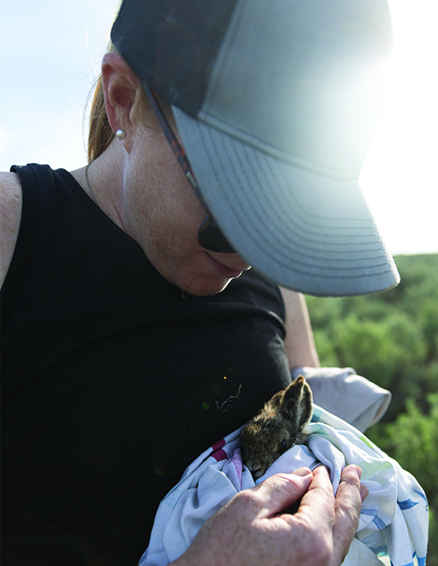
鈥淲hen you spend so much time, intimately connected with something like that, as you do in a PhD program, it鈥檚 hard to just let it go,鈥� Milling says. 鈥淧ygmy rabbits are not pets, of course. But they become an important part of your life. I have always said that I work in systems, and not with species. But pygmy rabbits are a really interesting species in a really phenomenal system.鈥�
For their part in the race to preserve Washington鈥檚 pygmy rabbits, Milling and her students are chiefly interested in investigating the types of places that make for successful rabbit homes. 鈥淲hat does the habitat structure look like? What does the sagebrush look like? What鈥檚 the thermal environment? Is it really hot in some places and really not in others? Those are the sorts of questions we鈥檙e asking.鈥�
The answers she says, will help project managers zoom in on what鈥檚 working and what鈥檚 not for the rabbits. As of now, Milling says, 鈥渨e鈥檙e just not capturing that micro level, as we measure some of these larger-scale variables.鈥�
Doing better for bunnies, in other words, means getting up close and personal with soil and sage. With wind and water. With blazing sun and blinding snow. It means learning to see things from the perspective of a furry animal not much bigger than the palm of your hand. The job is especially challenging because, while Milling and the other scientists on her team know a lot about the nature of rabbits鈥� habitat, their understanding of the creatures themselves is scant 鈥� especially in the Columbia Basin, where populations were uprooted before anyone started to study them.
What scientists do know is that pygmy rabbits鈥� survival rates are incredibly low. Though they have as many as three litters a year 鈥� they do, in fact, breed like bunnies 鈥� in reality less than half of kits born in the wild survive to the next year. This, of course, adds to the difficulty of establishing them in new areas.
Still, project scientists are learning a lot about what works and what doesn鈥檛. 鈥淲e鈥檙e out there to identify the characteristics that lead to increased success,鈥� Milling says. 鈥淥nce we know those, then we can go out and find them on the landscape, both for new enclosure sites, and, ultimately, new reintroduction sites.鈥�
Finding such suitable sites is key, in no small part because Washington鈥檚 pygmy rabbits occupy a unique ecological niche. They have, after all, been isolated from potential breeding partners for at least 10,000 years 鈥� possibly as long as 115,000 years, according to some estimates.
This separation explains why the Columbia Basin population is not only genetically distinct, but uniquely positioned to thrive in the challenging environment of central Washington.
Biologists call pygmy rabbits 鈥渟agebrush obligates,鈥� meaning they depend on the brush for survival. Washington鈥檚 portion of the sagebrush sea is home to perennial grasses and forbs that deliver meals in summer and fall. And as the only North American rabbit species known to dig their own burrows, pygmy rabbits also rely on the sagelands鈥� soft, crumby soils to excavate the tunnels they use to obtain shelter, to achieve body temperature regulation, and, crucially, to find safety from predators.
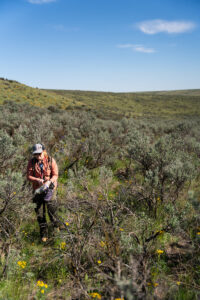
During a conversation in Milling鈥檚 51福利社 laboratory, one of her research assistants, Toby Eddy 鈥�25, describes gaining a deep appreciation for this landscape after methodically trudging through it on many sweltering days in the height of summer. His role? Checking burrow locations for signs of rabbit usage.
鈥淚t was dry and hot, for sure,鈥� Eddy says with a laugh. 鈥淎 lot of fighting through the sagebrush, trying not to destroy habitat, to be gentle as possible as I was going along. It can get monotonous, because you鈥檝e got to look as closely as possible to spot potential burrows under each bush. But you kind of get a sense for it as you鈥檙e out there, and eventually you start seeing where those burrows are.鈥�
Eddy came to Eastern after the conclusion of his service as an airman at Fairchild Air Force Base. He said working with veterinarians on the pygmy rabbit team was particularly rewarding, given his own interest in a career in vet med.
Beyond the actual undergraduate research experience, which has yielded him conference papers, poster-session presentations and admission to the highly selective veterinary medicine program down the road at WSU, Eddy emphasizes how his experience has driven home the stark contrast between value of a healthy sagebrush ecosystem and most people鈥檚 perception of it.
鈥淧eople see it as wasteful or useless,鈥� he says. 鈥淲hen I interact with people, I try to impress upon them how vitally important sagebrush is to the survival of so many species. Going out and seeing the fragmentation of the sagebrush in the pygmy rabbit鈥檚 natural range, just the declining health of the overall sagebrush habitat, was the most discouraging thing for me, for sure.鈥�
The effort to preserve both sage and rabbit, led by the state鈥檚 Department of Fish and Wildlife, began in earnest after a federal judge in 2001 ruled that Washington鈥檚 genetically distinct Columbia Basin Pygmy Rabbits, officially known as Brachylagus idahoensis, qualified for protection under the Endangered Species Act.
That status paved the way for Washington鈥檚 rabbits to join the ranks of our state鈥檚 鈥淪pecies of Greatest Conservation Need,鈥� a designation that, in turn, opened the door to participation in a wider, national initiative 鈥渢o develop conservation action plans for fish, wildlife and their natural habitats.鈥�
鈥淣one of it works if you鈥檙e not supporting the habitat, or making decisions that allow for the continued persistence of the animal, right?鈥� Milling says. Unfortunately, she adds, the barriers to maintaining, much less restoring, that habitat can at times seem insurmountable.
鈥淚t鈥檚 invasion by non-native species. It鈥檚 habitat destruction and loss associated with expansion of the human footprint,鈥� says Milling. 鈥淚n some areas it can be irresponsible grazing management. It鈥檚 wildfire. And then the weeds that follow wildfire. Finally, and perhaps most consequentially, it鈥檚 a completely disrupted, climatological regime where you鈥檙e getting these massive snowfalls and then massive floods, followed by heat domes and drought.鈥�
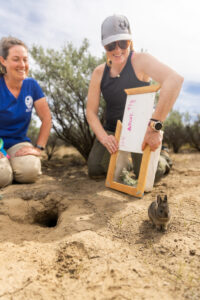
There are other challenges as well, adds Miranda Crowell, the wildlife biologist who currently heads up the pygmy rabbit project at the Washington State Department of Fish and Wildlife.
鈥淲ithout a doubt, habitat loss is the primary reason they鈥檙e endangered in the first place,鈥� says Crowell. 鈥淟arge-scale conversion to agriculture and overgrazing in the Columbia Basin has really fragmented their habitat. Thankfully, it鈥檚 getting a bit better now, partly due to the Conservation Reserve Program [CRP, a federal program that helps farmers remove environmentally sensitive land from production to protect soil, water, and wildlife habitat]. A lot of habitat has been replanted to sagebrush, which is helping the connectivity between suitable stands. The rabbits can use the CRP habitat too, which is great. They love it for some reason.鈥�
She says that within the enclosures, breeding must be carefully managed to combat inbreeding, a significant concern given the small founding population. All of Washington鈥檚 surviving pygmy rabbits, in fact, share some genetic information with their counterparts in Idaho, this because the 16 survivors from 25 years ago were too few to avoid ruinous inbreeding.
For today鈥檚 population, helping the bunnies make good matches means rigorous DNA sampling to track parentages, then scrambling individuals to, hopefully, create suitable love connections.
Another looming threat is disease. Rabbit Hemorrhagic Disease Virus serotype 2 (RHDV2) is a scourge among wild rabbits of all species, one that has devastated populations nationwide. Typically, it kills 90 percent of those infected. 鈥淚鈥檝e seen three different outbreaks in pygmy rabbit populations in Nevada,鈥� Crowell says. 鈥淚t was devastating.鈥�
While Washington鈥檚 pygmy rabbits have so far avoided the disease, the team isn鈥檛 taking chances. 鈥淟ast year,鈥� Crowell says, 鈥渨e were also conducting a vaccine trial against RHD-2. We were using Filavac, which is the vaccine from France, and now there鈥檚 a domestically made vaccine, Medgene. We wanted to test the efficacy of both vaccines because we didn鈥檛 know how our rabbits would respond to Medgene.鈥� Trapping last year to collect blood samples and check antibody responses 鈥� and subsequent follow-ups 鈥� went well. But it will take time to monitor the vaccines鈥� effectiveness over time.
After nearly a quarter-century of intensive -conservation work, the outlook for Columbia Basin pygmy rabbits is cautiously positive. 鈥淲e鈥檙e 14 years in,鈥� Crowell says, 鈥渁nd we鈥檝e learned things that have definitely helped the project a lot.鈥�
鈥淥verall, I think we鈥檙e headed in the right direction,鈥� she continues, ticking off the names of the many scientists and wildlife professionals who have played a role in turning things around, including Charlotte Milling, who served as a mentor to Crowell back when Crowell was an undergraduate at WSU.
 For her part, Milling is also keen to emphasize just how many people have dedicated a significant portion of their careers to the pygmy rabbits鈥� cause. People like Lisa Shipley, a professor of mammalian ecology at Washington State University, who, back at the project鈥檚 beginning, was instrumental in leading Washington鈥檚 entire wild population out of the sage-steppe and into the captive breeding that saved them from extinction.
And there is Janet Rachlow, professor and former department head for the University of Idaho鈥檚 Department of Fish and Wildlife Sciences. Over the years, her large fleet of students (Milling included) has greatly expanded scientists鈥� understanding of the species across its range. Also, Lisette Waits, a conservation geneticist at Idaho whose laboratory does the molecular work; the tracking of ancestry, parentage, and effects of locally adapted genes (for Washington鈥檚 pygmy rabbits, more genetic material from the Columbia Basin is better). With the help of these 鈥淥Gs鈥� and others, Milling says, the team continues to refine their methods, improving the data needed to improve recovery areas and discover more advanced approaches for strengthening existing populations.
For now, these tiny survivors continue to burrow through Washington鈥檚 shrub-steppe, each successful litter bringing the species one hop closer to recovery.
鈥淚 was literally screaming and crying,鈥� says Crowell, describing her elation at seeing this year鈥檚 first enclosure-born litter. 鈥淚 was freaking out that we hadn鈥檛 seen them yet.鈥�
She鈥檚 not alone. For the scientists and students who crouch in the heat and cold to study them, every flash of fur in the sagebrush remains cause for celebration. And just maybe, says Milling, the adorable look of the plush-toy-esque, Disney-film-worthy pygmy rabbits 鈥� perhaps the most charismatic mini-fauna ever 鈥� has a role to play in preserving them. 鈥淚t is hard to maintain professionalism with those animals,” Milling admits with a smile. Unlike other rabbit species that develop to grow large and ungainly, with buggy eyes, 鈥減ygmy rabbits retain their Disney features. They just stay precious.鈥�
鈥淧eople look at the sagebrush and they see nothing,鈥� she adds. 鈥淭hey see a wasteland… But pygmy rabbits, by virtue of their existence, counter that. People love them. And you only find them in sagebrush. So, you might say, as the pygmy rabbit goes, so does the sage. I really want to believe we can save both.鈥�