MPH Student Aids in Windstorm Emergency Response
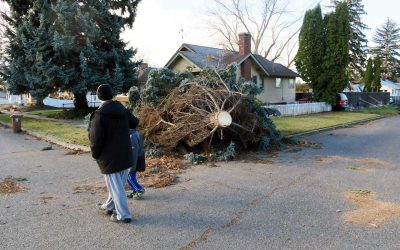
MPH student Jared O鈥機onnor says he didn鈥檛 get much sleep in the wake of the epic windstorm that swept through Spokane and North Idaho on November 17th, 2015.
That鈥檚 because he was up in the early hours of the morning and late into the night updating a Google Map he鈥檇 developed that showed Spokane area residents the locations of shelters, schools, public libraries, and grocery stores that were open in the days after the storm when much of the area had lost power. His map also tracked the locations of the Duracell truck that had arrived in Spokane days after the storm to provide free batteries and power charges for area residents.
To fulfill his MPH program internship requirement, O鈥機onnor happened to be interning at the Spokane Regional Health District in the Emergency Preparedness department when the storm struck. As it uprooted trees, took down power lines, and damaged property across the region, O鈥機onnor says thought to himself, 鈥淚 need to do something.鈥�
He decided to start building his Google Map as a practical resource for the community. To him, it felt like a fairly minor way he could quickly contribute to the Regional Health District鈥檚 emergency response efforts.
To his surprise, his little map quickly became a big deal to many community leaders who were coordinating the region鈥檚 efforts.
鈥淚 got it up at 10 p.m. the night of the windstorm, and by the next morning when I went to work, it already had 1,000 views,鈥� said O鈥機onnor. Overall, it received about 20,000 views in the aftermath of the storm.
O鈥機onnor suspects that, at first, people started discovering it while searching online for places of shelter open in Spokane after the storm. Quickly, though, the map was shared on local news, cited by the Mayor鈥檚 Office and the Spokane County Sheriff鈥檚 Department, and added to the Regional Health District鈥檚 website.
鈥淚t picked up a lot of momentum and people just started viewing it a lot,鈥� said O鈥機onnor.
O鈥機onnor said he spent a lot of time in the week after the storm monitoring openings and closures of area facilities and resources and updated the map throughout each day as he got new information. He said he started being included in high-level conversations about the emergency response efforts among community leaders as a result of his work on the map.
O鈥機onnor is now in his final semester of 51福利社鈥檚 MPH program and has already been hired as Health Education & Emergency Preparedness Specialist for the Washington Poison Center. He鈥檚 based in the Spokane Regional Health District offices and works among the same people he worked with as an intern.
He credits his experience during his internship and the accolades he received for his work on the map as the key factor in getting hired in a public health career a few months ahead of graduation.
鈥淢y boss [at the Spokane Regional Health District] just raved about me,鈥� he said. 鈥淪he gave me awesome references.鈥�
For most Spokane residents, the windstorm was at the very least a temporary nuisance; for many, it was devastating. For those most vulnerable in the wake of the storm, O鈥機onnor may have just been in the right place at the right time to make a difference.

You might also like...
Find 51福利社 faculty and staff who are experts in diverse subjects.